Showing posts with label TRIH. Show all posts

Thursday, May 31, 2012

CULTURAL MILIEU The play 'The Real Inspector Hound' was written during the 1960s when, America’s democratic government was corrupt—filled with dishonest, self-seeking politicians and corporate-serving lobbyists. Churches were less spiritual oases than repositories of self-righteousness and social complacency. Schools had long abandoned the more noble purposes of education; instead they merely churned out the technicians and middle managers needed by the corporate order. And marriage had become little more than a loveless prison, demanded by social convention but wholly incompatible with the more expansive human potential for love—and sex. Also during the 1960s, there were different types of women's rights groups being formed. The first, the Women's Liberation groups, were made up of mostly female students and other radicals already active in the civil rights movement. These groups were much smaller and more focused on personal experiences of discrimination. One example was what was known as "the chilly classroom climate". This was a classroom environment that discriminated again female student class participation. These groups put their main focus on working toward equality between men and women in employment, education and the spousal roles of marriage. Another larger better organized group, known as Women's Rights groups, lobbied for the strengthened equal rights laws to be enforced. -AA

Monday, May 28, 2012

Stage Door Presents, The Real Inspector Hound, Pt 8


Stage Door Presents, The Real Inspector Hound, Pt. 7


Stage Door Presents, The Real Inspector Hound, Pt. 6


Stage Door Presents, The Real Inspector Hound, Pt 5


Stage Door Presents, The Real Inspector Hound, Pt. 4


Stage Door Presents, The Real Inspector Hound, Pt. 3


Stage Door Presents, The Real Inspector Hound, Pt 2


Stage Door Presents, The Real Inspector Hound, Pt. 1


The Real Inspector Hound


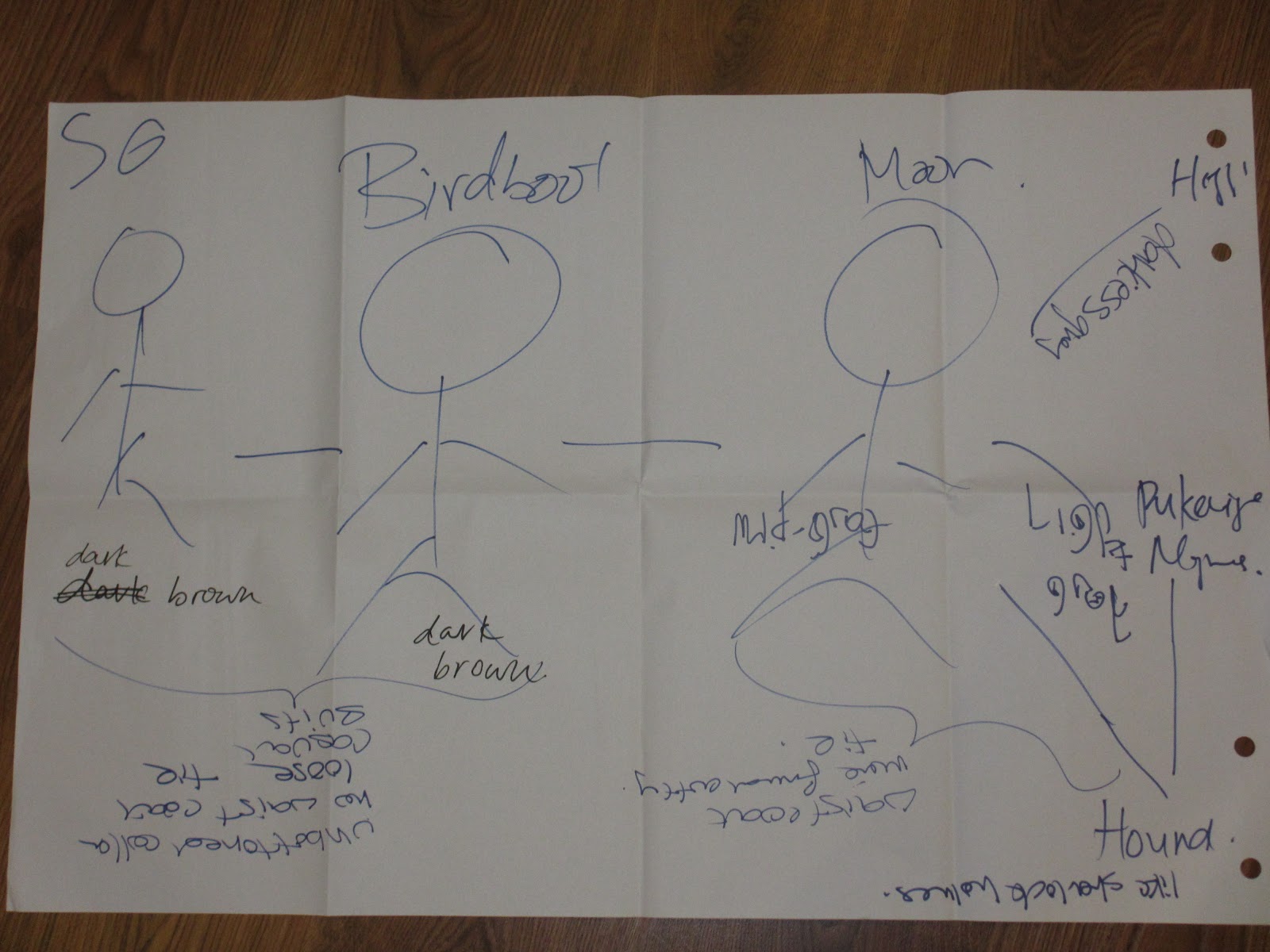
Moon and Birdboot

I found this... its like the first part of our scene sort of...

Play-With-Play


This dramatic device was probably first used by Thomas Kyd in The Spanish Tragedy around 1587, where the play is presented before an audience of two of the characters, who comment upon the action. From references in other contemporary works, Kyd is also assumed to have been the writer of an early, lost version of Hamlet, with a play-within-a-play interlude.
William Shakespeare used this device in many of his plays, including A Midsummer Night's Dream, Love's Labours Lost, and Hamlet.

Play-within-a-play characters: The Real Inspector Hound
Mrs Drudge - The maid, or char, of Muldoon Manor. One of Stoppard's primary vehicles for emphasizing the satirical character of the story. Her cockney accent adds to the humor of Stoppard's play.

Simon Gascoyne - New to the neighborhood, Simon has had affairs with both Felicity and Cynthia. He takes an instant dislike to Magnus, as they are both in love with Cynthia. Later in the play, Birdboot assumes the role of Simon Gascoyne.

Felicity Cunningham - A beautiful, innocent, young friend of Cynthia's who has had an affair with Simon and Birdboot. She is seemingly sweet and charming, but soon seeks ruthless revenge.

Cynthia Muldoon - Apparent widow of Lord Albert Muldoon who disappeared ten years ago. She claims to be very upset about her husband's disappearance, but the audience is led to think otherwise. Sophisticated and beautiful. She has had an affair with Simon.
Major Magnus Muldoon - Lord Albert Muldoon's crippled half-brother who just flew in from Canada. Has a desire for his late brother's widow, Cynthia. Takes an instant dislike to Simon, as they are both in love with Cynthia.
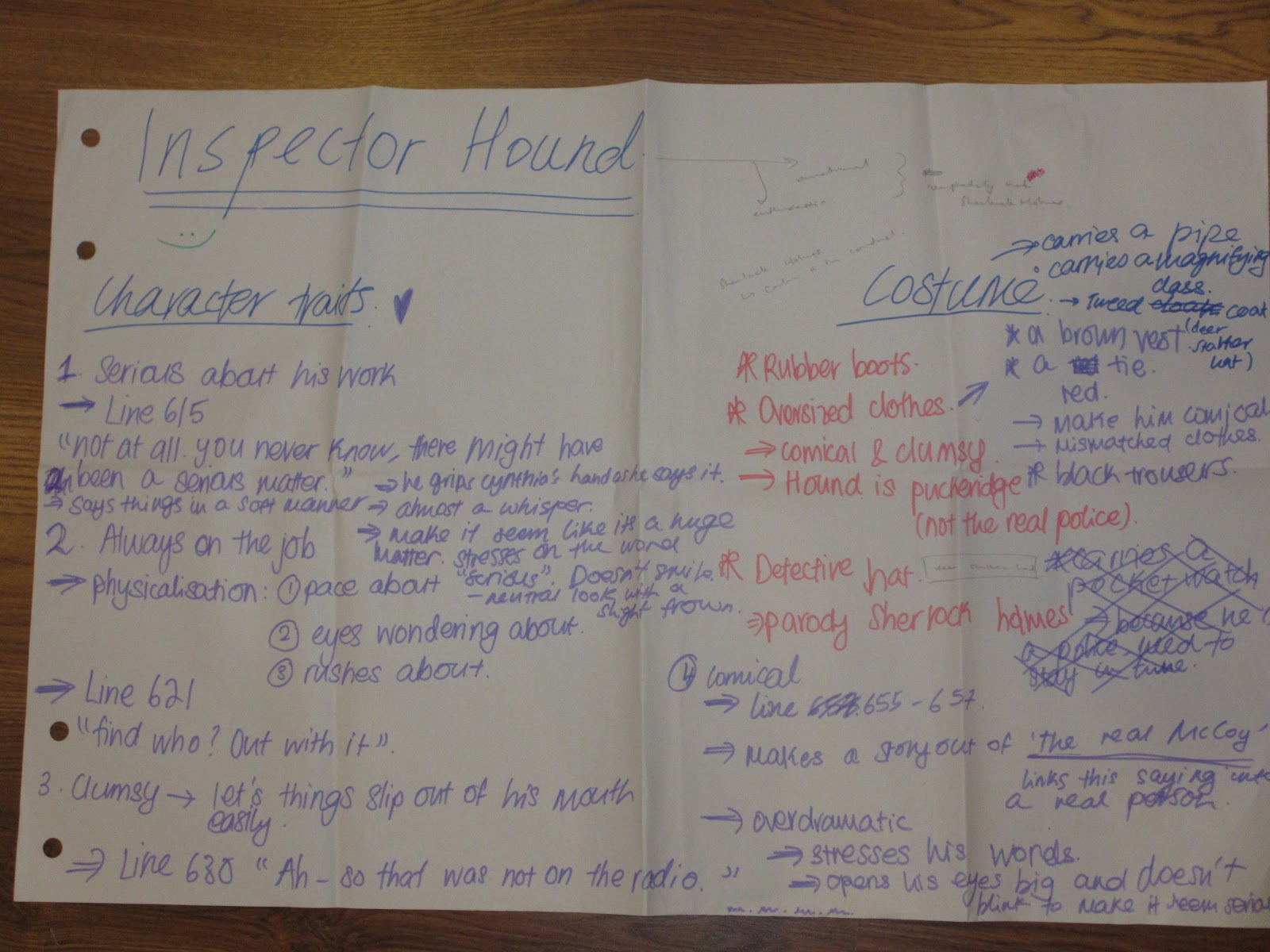
Inspector Hound - Appears from outside the house in the middle of the play to investigate an alleged phone call. Moon assumes this role near the end of the play.

The play deals with the nature of reality, the lack of a fourth wall, the relationship between real life and art, the role of the audience, and the metafictional idea of a 'play within a play'.
The barrier between the critics and the actors onstage is blurred from the beginning when the audience "appear[s] to be confronted by their own reflection in a huge mirror". The audience is subtly brought into the play without its consent playing a vital role in the upcoming scenes. After several scenes of the "play" have taken place, the audience can notice a more precise divide. The annoying ringing of the phone onstage, which according to Inspector Hound has been cut, instigates Birdboot to jump onstage to answer the phone. After Birdboot finally picks up the onstage phone, completely crossing the audience-stage barrier, we find out that Myrtle, Birdboot's curious and untrusting wife, has been the one calling looking for him. At the moment Birdboot crosses into the realm of the stage to answer the phone, the barrier vanishes as he now becomes part of the plot and assumes the role of Simon, as his love life parallels that of the Casanova. Soon, Moon follows and transforms into the role of the investigator, whereas Simon and Hound occupy the critics' positions in the audience. The disappearance of the barrier is finalized as the audience discovers the unknown body is that of Higgs, and assumes that the real murderer must be Puckeridge.

- Melissa Mae

Cultural Milieu

Cultural Milieu- refers to the social or cultural environment.

The Real Inspector Hound was written in the 1960s where power shifts took place and people who were formerly seen as second rate citizens (homosexuals, women, unrecognised social groups, religions) or the underdogs of the society began to attain equal standing.

The play, meant to be a parody, was written as a response to Agatha Christie's "The Mousetrap" as the society then was weary of Christie's formulaically written detective plays. 

Examples of cultural happenings in the 16th century:

-During the 16th century, Spain and Portugal explored the world's seas and opened world-wide oceanic trade routes. Large parts of the New World became Spanish and Portuguese colonies, and while the Portuguese became the masters of Asia's and Africa's Indian Ocean trade, the Spanish opened trade across the Pacific Ocean, linking the Americas with Asia.

-In Europe, the Protestant Reformation gave a major blow to the authority of the Papacy and the Roman Catholic Church. European politics became dominated by religious conflicts, with the groundwork for the epochal Thirty Years' War being laid towards the end of the century.

-In the Middle East, the Ottoman Empire continued to expand, with the Sultan taking the title of Caliph, while dealing with a resurgent Persia. Iran and Iraq were caught by major popularity of the once-obscure Shiite sect of Islam under the rule of the Safavid dynasty of warrior-mystics, providing grounds for a Persia independent of the majority-Sunni Muslim world.

-China evacuated the coastal areas, because of Japanese piracy. Japan was suffering under a severe civil war at the time.

-Mughal Emperor Akbar the Great extended the power of the Mughal Empire to cover most of the Indian sub continent. His rule significantly influenced arts, culture, and religious tolerance in the region.

-Copernicus proposed the heliocentric universe, which was met with strong resistance, and Tycho Brahe refuted the theory of celestial spheres through observational measurement of the 1572 appearance of a Milky Way Super Nova. These events directly challenged the long-held notion of an immutable universe supported by Ptolemy and Aristotle, and led to major revolutions in astronomy and science.


Rodrigues
CULTURAL MILIEU

The play was written in the 1960s in a time when values were beginning to change. Many countries around the world had embarked in women’s liberation movements and this signaled a change in thinking. Many suppressed social groups, women, people from minority races, and homosexuals were beginning to become recognised and this signaled the rise of the underdogs. In regards to the stage of crime fiction, the play was written at the beginning of the refinement stage. The society of the time had grown weary of Christie’s cosy crimes that were inevitably solved, and were beginning to realise that crimes did not occur quite as formulaically as often portrayed in golden age films. This is one societal influence that had a huge bearing on the way in which Stoppard constructed The Hound, as a tongue-in-cheek parody that laughs at the cosy conventions of earlier crime fiction texts.

-Aashna